Sarbourma
Sarbourma (sometimes spelled sarburma) is a traditional Armenian pastry that's been passed down in my family for generations: very thin dough, lots of butter, walnuts, and honey. We've never been able to find it online, and it's one of my favorite desserts, so I'm publishing it here.
Where it comes from
Most of this is from my grandpa digging through old family records, so some of it may be inaccurate.
The recipe comes from my dad's side. My grandpa's mother was Grace Kaprelian, and her parents were Roupen Kaprelian and Antaram Douzlajian. Roupen was from Sivas, and the Kaprelian (and Bogosian) families had established businesses here. Things weren't going well for Armenians in Turkey, so through the "Armenian grapevine," a marriage was arranged, and Antaram was sent here on her own, before the genocide. They were married on November 22, 1913, at Montrose Hall in Chicago (the invitation was sent out by Roupen's brother, Megerditch), and later moved to Wisconsin. Grace's Armenian name was Shenorig, and her sister Louise's was Arshalous.
As for why we can't find sarbourma anywhere, we honestly don't know. The closest thing my grandpa found is bourma (also spelled boorma), an Armenian phyllo pastry with walnuts, but nothing online mentions "sarbourma," and traditional bourma isn't made the way my great-great-grandma made it. Armenian words were usually anglicized by sound, so the spelling isn't consistent, which doesn't help. Maybe we're just bad at searching in Armenian (although we have tried). Maybe the recipe was lost in the genocide. Or maybe my great-great-grandma just invented it one day when she was too lazy to make paklava.
Recipe
Everything below is 100% my grandpa's words and photos, from when he digitized the recipe as a PDF. All I changed was the formatting. The one exception is the "sandwich" tip at the very end, which he sent me later (also in his own words).
Cold-weather holidays are especially enjoyable around the Hall family because we keep alive an old recipe from my Armenian grandmother. Unfortunately, my German side is only represented by a strong appetite for veal bratwurst and German-style potato salad... maybe some sauerbraten... but that's not too bad in the summer.
But, back to the recipe... It is quite simple:
- very thin dough
- lots of butter
- chopped walnuts
- honey
Putting it together is the hard part.
I used to roll out the dough the traditional way... on a broom handle. That consisted of a small lump of very rich dough [eggs, butter] rolled out paper thin. I've gotten lazy as I've gotten older and the family has gotten larger... and the amount of pastry I have to make has gotten proportionally larger.
Now I use Greek Phyllo dough... After chopping the walnuts and melting the butter, I lay out four sheets of dough and spread the butter with a small brush.
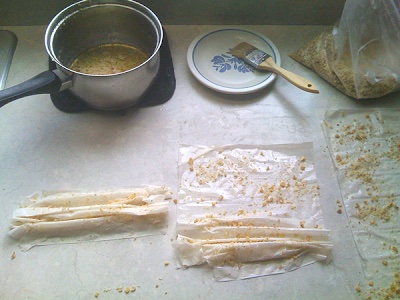
The key is to get the butter just right. Never bring the butter to a boil. Melt it slowly... just enough to get the butter liquid, but not enough to break up the butterfat. If you have a warmer element on your stove, use that to keep the butter warm and liquid.
Then sprinkle the chopped walnuts over the buttered dough...
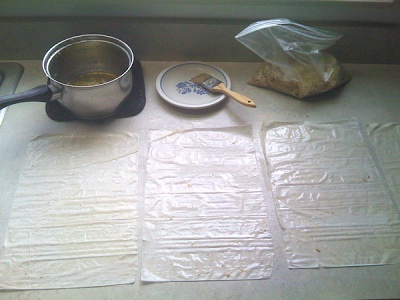
...and "accordion" the dough as shown below.
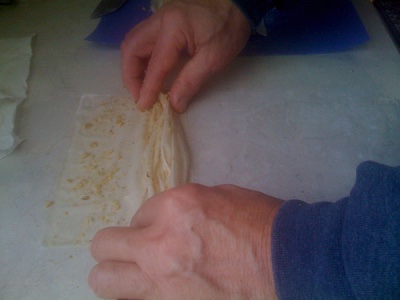
Arrange several sheets as shown below...
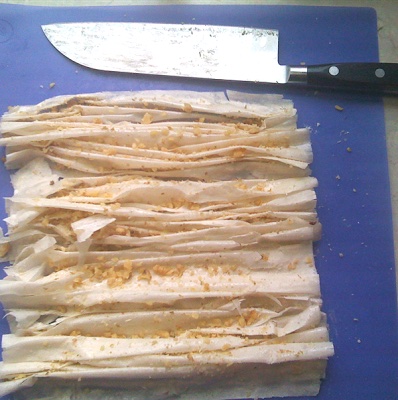
...and cut carefully. A very sharp knife can be simply pressed downward to make the cuts.
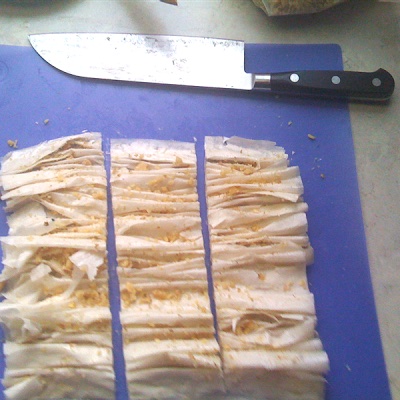
Place the cut strips into a baking pan. I use some old, heavy-gauge, stainless-steel pans that heat evenly and don't warp from the heat. Four sheets of dough will fill one row of the pan.
Note the presence of a large spatula which is needed a little later.
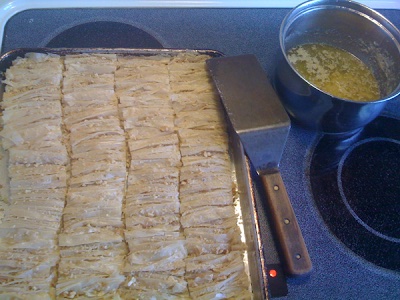
Pour the melted butter over the pastries so that the dough is wet, but not swimming in the butter. Usually, this is about 1 to 1-1/2 cups for the 12" x 18" tray.
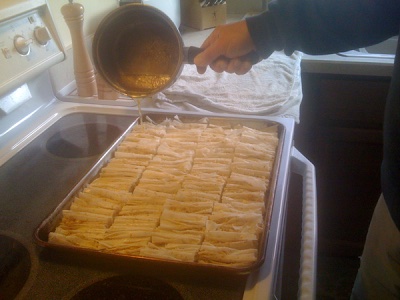
Bake the pastries about 14 [13-15] minutes at 330°F. This is about right for our electric oven, but gas ovens may get hotter and cook quicker at that setting. You'll have to adjust for your own oven. Ideally, the dough should be lightly browned... just starting to crisp up, but still flexible. [Note that cooking times may be longer for the initial phase if you pack the pieces too tightly.]
Then carefully tilt the pan and hold the pastries in place while you drain the excess butter from the pan. About 1/2 minute of draining should be sufficient.
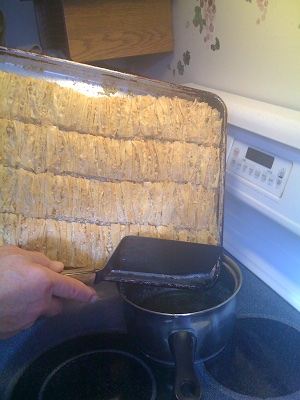
Then put back in the oven for 4 [3-5] minutes until the pastries are golden brown and repeat the draining of the butter until most of the excess is drained. That may take a minute. It should look like this.
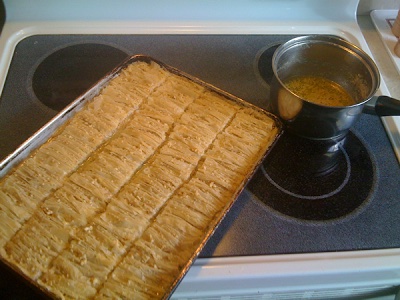
Let the pastries cool down and then drizzle honey over the strips in the pan.
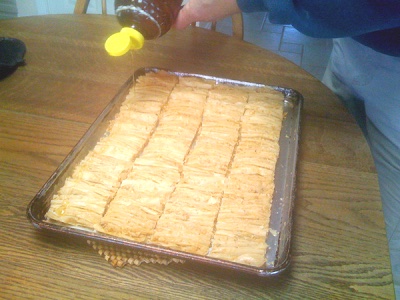
Serve and enjoy. It won't matter if you are Armenian, German, Irish, African or whatever. You will love this.
Oh, one more thing. After you take the dough sheets out of the box, place them on a towel covered with wax paper, then cover the dough with additional wax paper and a damp towel on top of that. That "sandwich" will help keep the dough from drying out before you get a chance to use it.
- damp (not soaking wet) towel
- wax paper
- dough sheets
- wax paper
- dry towel