Everything You Need to Know About AI
This post is for people who know nothing about AI. If you already know what AI is and most of the terms below, you can skip it. It's here because I plan to write future posts about AI that require knowing all or most of this, and I'd rather link to this post than explain the basics each time.
What is AI?
AI stands for artificial intelligence, and it is an umbrella term used to describe algorithms that seem "intelligent." Its meaning has changed over time as technologies improved, though, so it really refers to novel technologies. For instance, autocomplete (usually based on Markov chains) used to be considered artificial intelligence, but the meaning has shifted towards mostly neural networks (from now on I will refer to them as NNs). That includes image and video generation models using diffusion; complicated hybrid models and technologies like Waymo self-driving cars; and language models, specifically large language models (LLMs), which are usually GPTs, a specific LLM architecture.
For the rest of this blog post, when I refer to AI, I am referring to the general concept of artificial intelligence technologies with an emphasis on LLMs, or just LLMs.
Terms Worth Knowing
I have compiled a list of terms and ideas about AI that are worth knowing, both for this article and in general if you don't already know them:
-
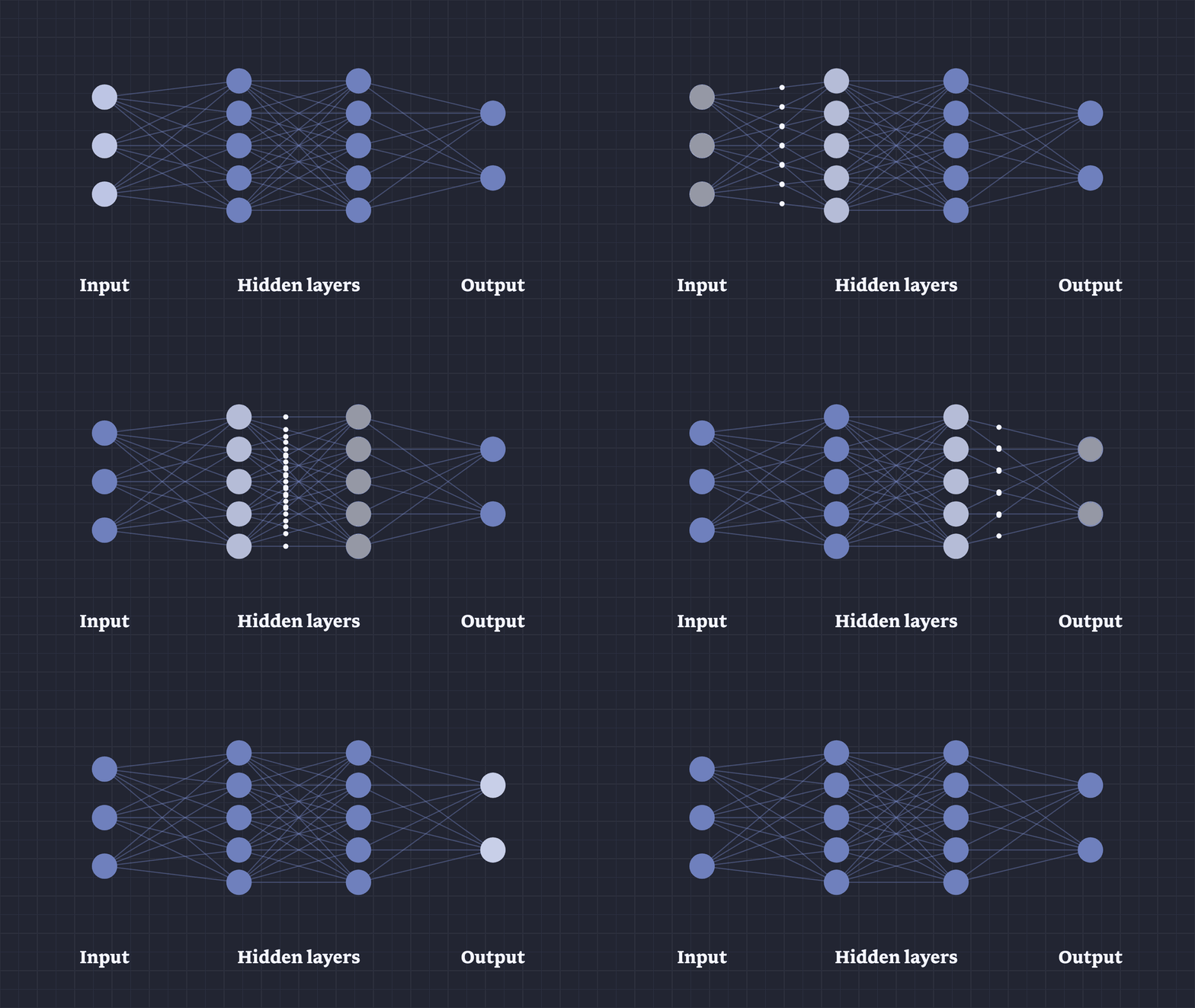
NNs (Neural Networks): A computer system modeled after the human brain that learns to recognize patterns and make decisions by processing examples instead of following a strict set of rules.
-
Model: A computer program or mathematical system that has been trained on data to recognize patterns, make predictions, or generate new content. Types of models include vision models, language models, vision language models, decision models, etc.
-
Training: The process of teaching an AI model to recognize patterns and improve performance by adjusting its internal parameters using data.
-
Pretraining: The initial training phase in which a model learns general patterns and capabilities from large datasets, typically using self-supervised learning.
-
Post-Training: Additional training performed after pretraining to improve a model's usefulness, reasoning abilities, instruction-following, and alignment with human preferences.
-
Fine-Tuning: Further training an existing model on specialized data to improve its performance on particular tasks or behaviors.
-
Inference: Using a trained model to generate predictions, answers, or outputs from new inputs.
-
Tokens: Small units of data processed by AI models. In language models, tokens can represent words, parts of words, or punctuation.

-
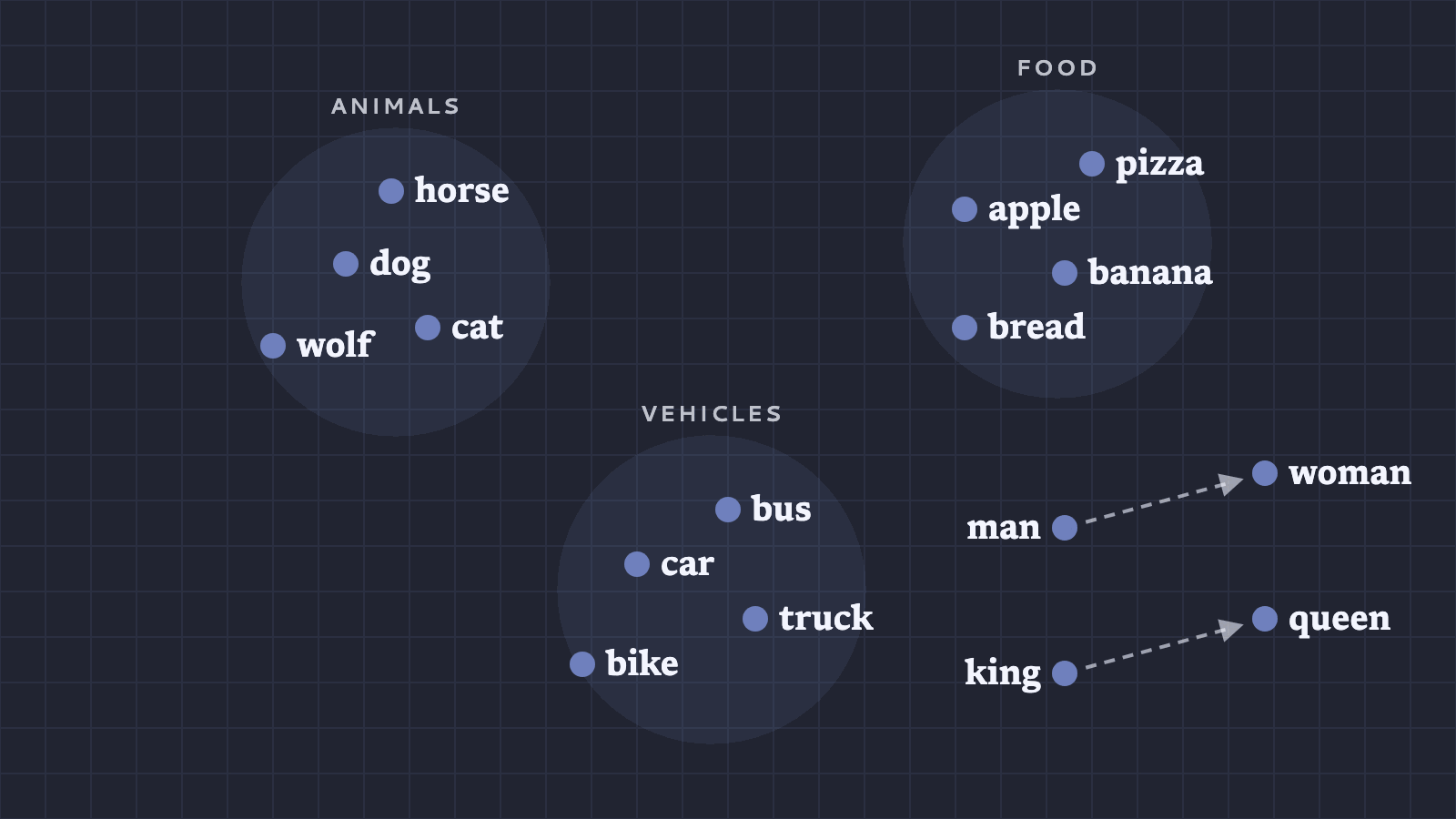
Embeddings (Vector Spaces): A way of turning things like tokens, words, or images into lists of numbers (vectors) so a model can work with them. Each vector is a point in a space with hundreds or thousands of dimensions, and similar things end up close to each other, so "dog" ends up near "wolf" and far from "banana." Directions in the space can mean things too. The classic example from word2vec is that going from "man" to "woman" is about the same move as going from "king" to "queen." This idea is useful even outside of AI. You can think of anything as a point in a giant space of all possible things, with one dimension for every property it could have, which is sometimes called thingspace. A category like "bird" is then just a cluster of points in that space.
-
Parameters: Numerical values, primarily weights and biases, learned during training that determine how a neural network processes information.
-
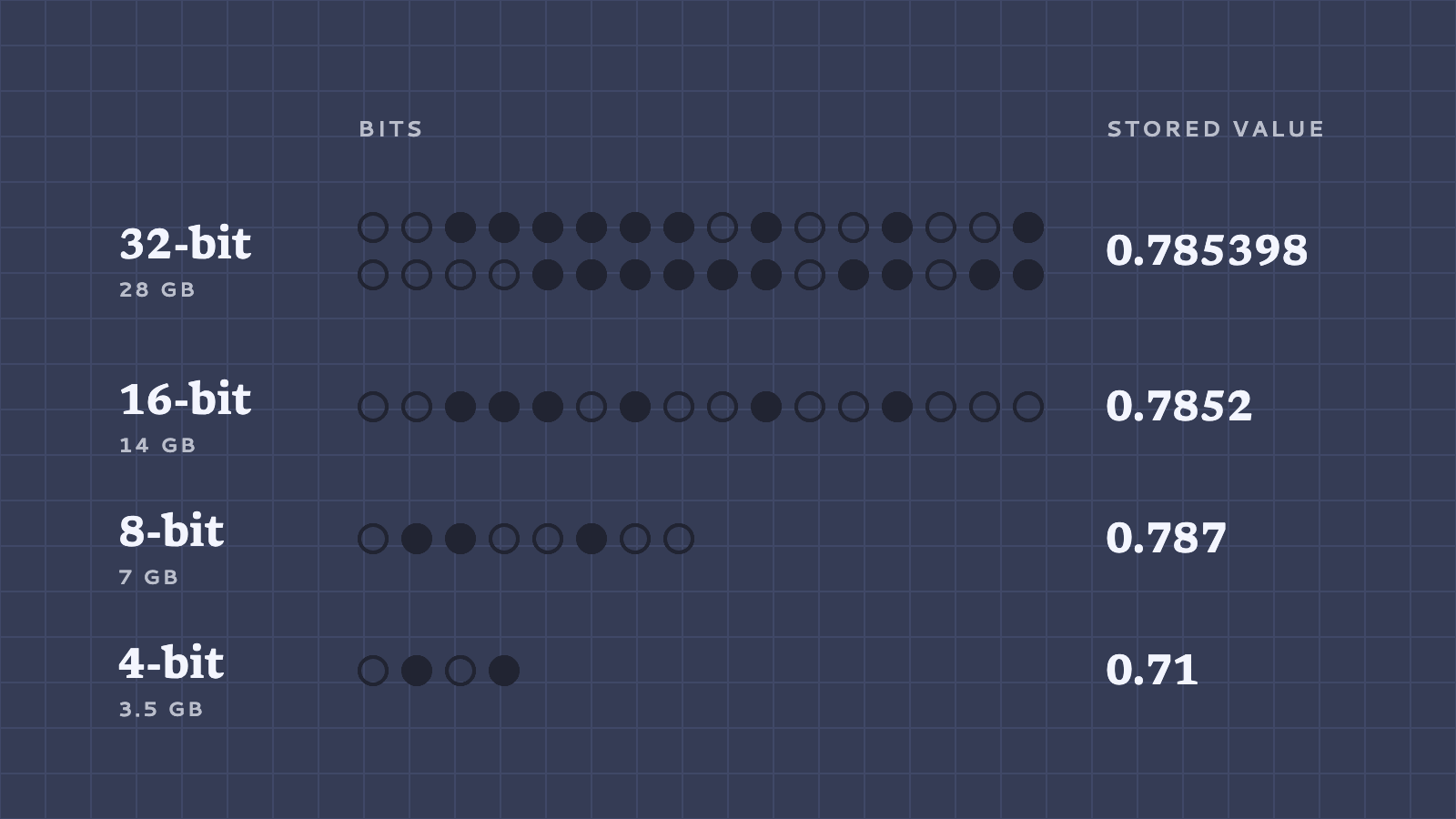
Quantization: Using fewer bits to represent each parameter. This makes models smaller and faster, but loses quality.
-
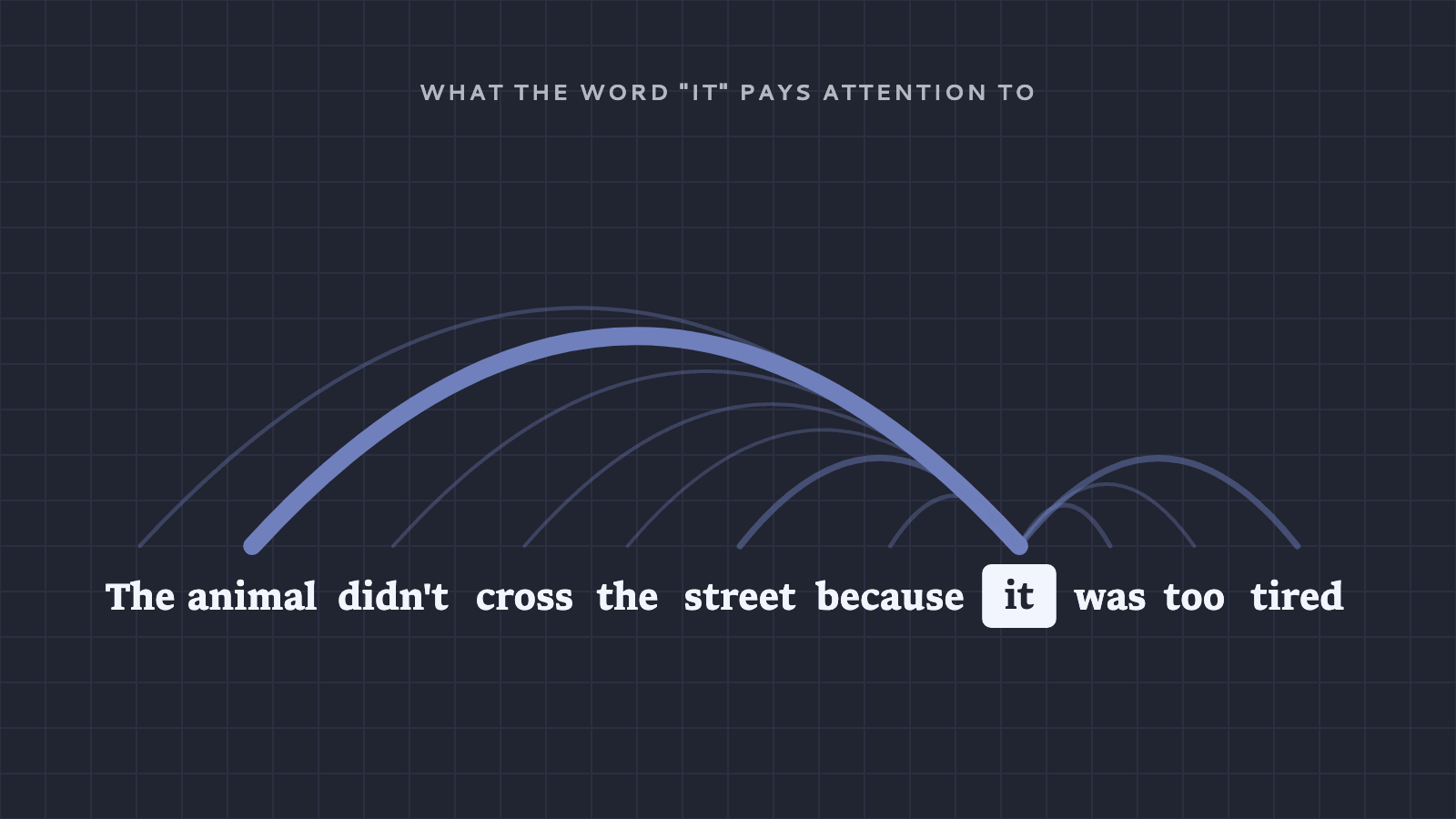
Attention: A mechanism that allows a neural network to weigh the relevance of different parts of its input when generating outputs. This is the main idea behind transformers.
-
Transformer: A neural network architecture built around attention, introduced in the 2017 paper Attention Is All You Need. Almost all modern LLMs are transformers.
-
Backpropagation: An algorithm that calculates how each parameter contributes to a model's error, enabling the model to learn through adjustments. It was popularized for NNs by this 1986 paper.
-
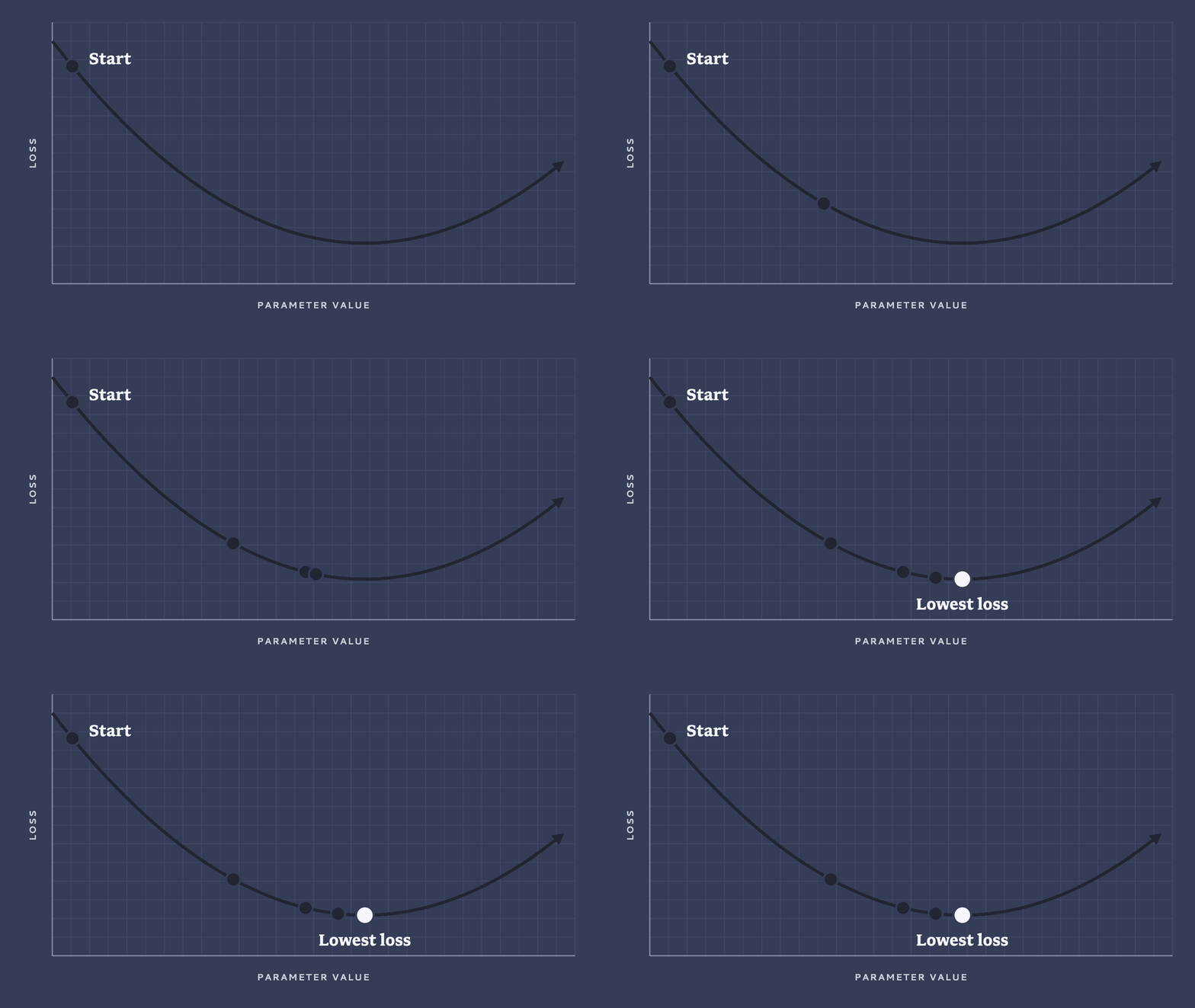
Gradient Descent: An optimization algorithm that updates a model's parameters in the direction that reduces its loss (error).
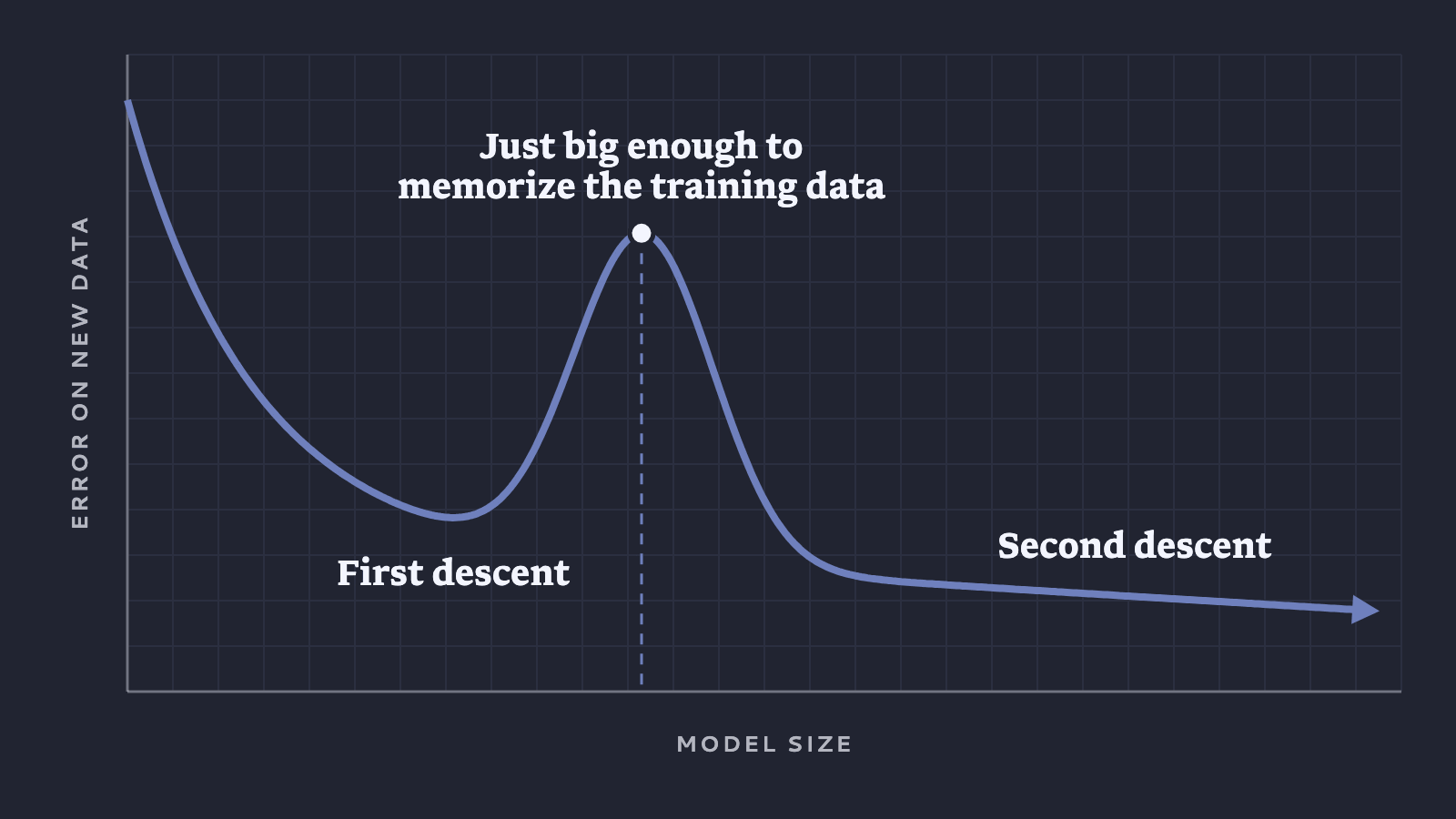
Side note: Double Descent. The classic idea in machine learning was that if you make a model too big for its training data, it overfits, meaning it memorizes the training examples instead of learning general patterns, so it does worse on new data. Double descent is the observation that if you keep making the model bigger past that point, the error on new data goes back down, often lower than before. It has been seen in many kinds of models, including NNs (paper, paper for deep learning), and it can also show up when training for longer. It helps explain why very large models can still do well on data they haven't seen.
-
Large Language Model (LLM): An AI model trained on large amounts of data to understand and generate human language.
-
GPT (Generative Pre-trained Transformer): A type of LLM that is a transformer pretrained on huge amounts of text to predict the next token. OpenAI introduced the first one in 2018. ChatGPT is the most well known, but most chatbots today, like Claude and Gemini, are built the same basic way.
-
Reasoning Models: LLMs that have the ability to generate "thinking tokens." Think of this as giving the LLM a scratchpad before it answers to write its ideas down and draft answers.
-
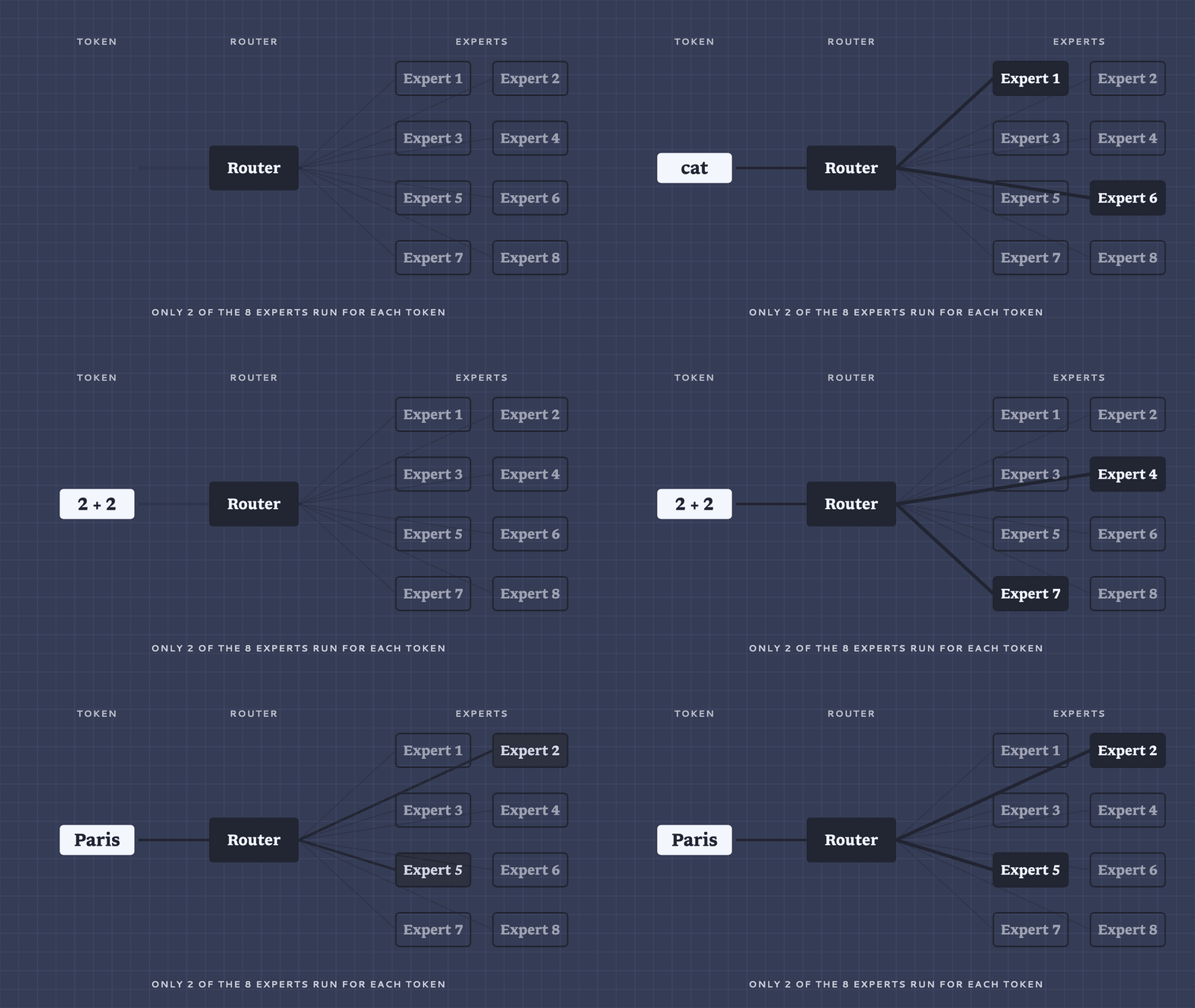
MoE (Mixture of Experts): A type of LLM where, rather than being dense, the model is broken up into smaller pieces called experts, so only a few of them need to be run for each token. This makes the model faster and more efficient. The modern version comes from this 2017 paper.
-
AI Agents: Models that are given tools to interact with various systems. For example, an LLM with access to writing files to a disk and running code would be a coding agent.
-
Tool Use: The ability of AI to interact with external systems, such as search engines, calculators, databases, or software, to perform tasks.
-
Autonomy: The degree to which an AI system can make decisions and execute tasks independently without continuous human direction.
-
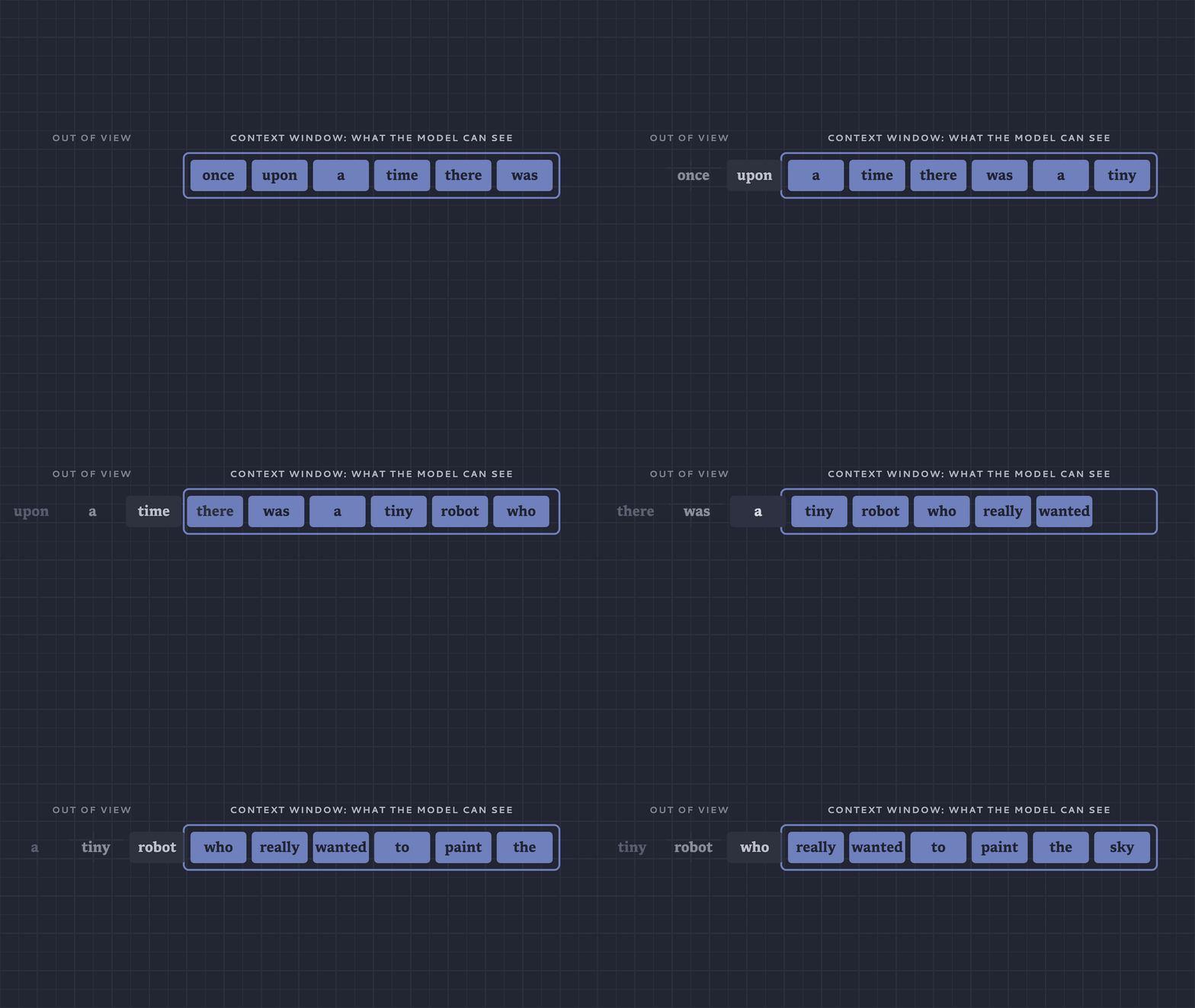
Context Window: The maximum amount of information, measured in tokens, that an AI model can process at once.
-
Prompt: The instructions, questions, or information provided to an AI model to guide its response. Models are given the current thing the user asks, along with previous messages and a system prompt that acts as instructions for how to act.
-
Hallucination: When an AI model generates information that is false, fabricated, or unsupported while presenting it as factual. This is a big problem in agentic research and chatbots.
-
Reinforcement Learning (RL): A machine learning approach in which an AI system learns to make better decisions by optimizing its behavior based on rewards or feedback.
- RLHF (Reinforcement Learning from Human Feedback): A training method that uses human preferences or evaluations to guide a model toward more helpful, accurate, or desirable responses (paper).
- RLVR (Reinforcement Learning with Verifiable Rewards): A training method that rewards models based on objectively checkable outcomes, such as correct mathematical answers or passing code tests. Particularly useful for improving reasoning capabilities. The name comes from the Tülu 3 paper.
- RLAIF (Reinforcement Learning from AI Feedback): A training method that uses evaluations or preferences generated by another AI model rather than relying entirely on human feedback (paper).
-
Supervised Fine-Tuning (SFT): A post-training method in which a model learns from examples of desired inputs and outputs, such as questions paired with high-quality answers.
-
Interpretability: The study of understanding and explaining how AI models make decisions, produce outputs, and represent information internally.
-
Mechanistic Interpretability: A branch of interpretability that attempts to reverse-engineer neural networks by identifying the internal features, computations, and circuits responsible for their behavior.
-
Alignment: The process of ensuring AI systems behave in ways consistent with intended human goals, values, instructions, and safety requirements.
-
AI Safety: The research and engineering field focused on preventing AI systems from causing unintended harm, including through misuse, failures, or loss of control.
-
AGI (Artificial General Intelligence): A proposed form of AI capable of performing a broad range of intellectual tasks at or above average human-level ability. Its definition is contested, particularly regarding what qualifies as human-level intelligence and generality.
-
ASI (Artificial Superintelligence): A hypothetical form of AI that significantly exceeds human intellectual capabilities across virtually all cognitive domains. Its definition is contested, particularly regarding how intelligence beyond human capabilities should be measured.
-
P(doom) (Probability of Doom): A subjective estimate of the probability that advanced AI causes an existential catastrophe, such as human extinction or permanent human disempowerment. Estimates vary widely, and there is no universally accepted definition of what counts as "doom" or the relevant timeframe.
-
Existential Risk (X-Risk): The risk of an event that could cause human extinction or permanently destroy humanity's potential for future development.
-
Recursive Self-Improvement (RSI): A hypothetical process in which an AI system repeatedly improves its own capabilities, potentially enabling increasingly powerful subsequent improvements.
-
AI Takeoff: A hypothetical period during which AI capabilities advance rapidly, potentially transitioning from human-level intelligence to superintelligence. The possible speed and likelihood of such a transition are debated.