ESPR
Welcome to my "review" of the European Summer Programme on Rationality.
Disclaimer: I will be leaving out many details, names, and other things about the camp in this post intentionally.
The location
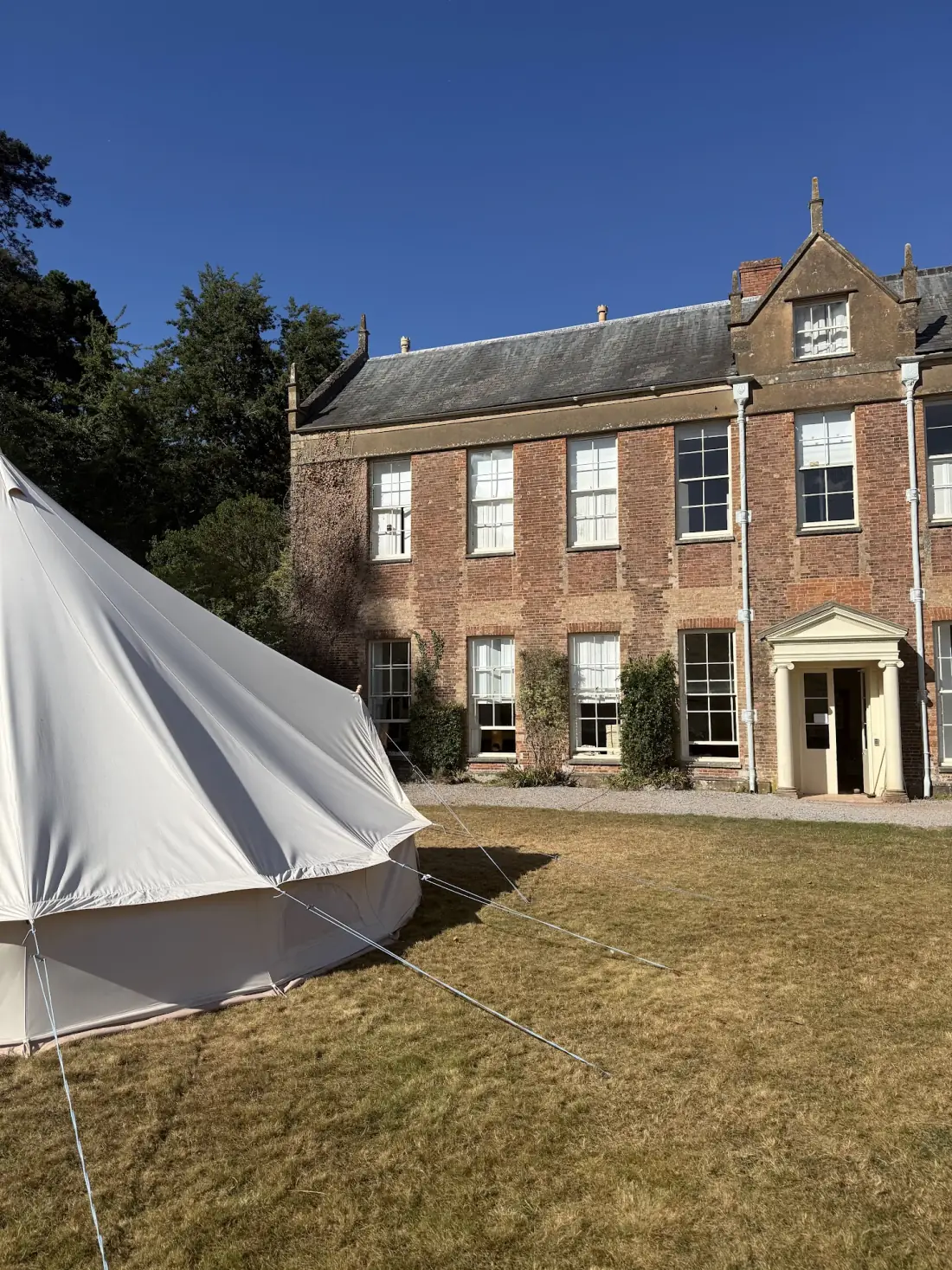
In 2026, ESPR was held in rural England. The venue was beautiful, and the camp's operations staff had set it up well for the program.
The place was in essence a mystical manor with sprawling grounds: rolling hills all around with livestock grazing, and a few patches of forest we got the chance to explore. Overall the location was absolutely impeccable.
The people
The one name I'll use is Gavin's, the camp lead (and one of the coolest, smartest, and most interesting people I've ever met). ESPR was genuinely an amazing experience because of the people.
Every single person was interesting to talk to, and I learned so much about everything from other cultures to AI to cooking to rationality itself. I believe the reason for this is the "secretive" selection process. Basically, Gavin did a great job finding interesting attendees for ESPR.
The camp itself
The camp is very intentionally vague about its structure and schedule, so if you're curious I'd advise you to check the official website. I won't be going in depth here. During my session there were lessons from brilliant instructors, and I learned a lot about the world and myself.
Some of the things I learned about at camp:
- Information theory
- Bayesian rationality
- The importance of journaling
- Goodhart's law
- Goals, and what to do with your life
- Morality
- The etymology of the word "hobby"
The camp runs on a high degree of freedom: you aren't required to do anything, and participants can do essentially whatever they want (except commit arson). One afternoon, for instance, we all went and climbed trees.
That freedom means you can do some super cool stuff. One thing I did was make a 1v1 scavenger hunt: two people race around camp with Android phones, scanning NFC chips hidden in various places. Each chip held a riddle (about math, English, rationality, or the camp itself) and the first player to finish all the riddles won.
The culture
ESPR had a really unique culture. People were remarkably open, and there were some interesting and honestly spectacular norms. Two stuck with me: conversational pits of despair and one-on-ones.
The pits of despair were topics that suck you in and create a conversational loop. The two big ones were American politics and AI. It wasn't that discussing them was off-limits, but that you should do it somewhere private, so you don't pull everyone nearby into the same spiral, and that you should stay aware of whether you've fallen into a loop.
This differed from the general vibe of conversations at ESPR, which were encouraged to be public: held in common spaces, in English, with a clear gap for someone new to join. The pits were an exception to this norm, to prevent the camp from becoming one long looping discussion.
The other exception was one-on-ones: scheduled conversations between two people, about whatever you like. Because of the extraordinary people at ESPR, these turned out to be the most valuable part of camp for me, and a reliably good way to actually connect with someone.
They were useful enough that I want to bring them into my normal life: scheduling one-on-one chats with my friends far more than I used to, and hopefully staying in touch with other ESPR participants over online ones.
Fun riddles
Here are some riddles I first heard at ESPR. I haven't solved all of them, but I believe some of you can.
The islanders. On an island, 100 perfect logicians each have either blue or brown eyes. Everyone can see everyone else's eye color, but not their own, and they cannot discuss eye colors.
Each day, everyone simultaneously chooses whether to raise their hand:
- Blue-eyed people who raise their hands receive a benefit.
- Brown-eyed people who raise their hands are harmed.
- Everyone sees who raised their hand.
On the first day, nobody raises their hand. Then a traveler publicly announces: "At least one person here has blue eyes."
In reality, 99 islanders have blue eyes and one has brown eyes, but the islanders are not told these numbers. What happens in the following daily votes?
Checkmate on a torus. Consider an 8×8 chessboard where both the rows and the columns wrap around, so the board is topologically a torus. Find a legal position with the minimum total piece value in which the lone black king is checkmated.
- Black has only a king.
- White has a king and any number of non-pawn pieces.
- No pawns allowed.
- Standard piece values: queen 9, rook 5, bishop 3, knight 3, king 0.
What's the minimum possible total value of White's non-king pieces?
A polynomial with a half-open image. Does there exist a polynomial f(x, y) in two real variables such that f(x, y) > 0 at every point in the plane, and every positive real number occurs as a value of f? Equivalently: is there a polynomial whose image is exactly the open interval (0, ∞)?
The mirror. When you look at yourself in a flat mirror, it appears to swap left and right, but not up and down. Why?
One last thing
ESPR was a genuinely life-changing experience, and I'm very grateful to have gotten the chance to attend and to meet so many incredible people.
See more at espr.camp.